Apple Silicon Evolution (vs Top Competitors) over the years
Posted on Oct 1, 2022
tl;dr:
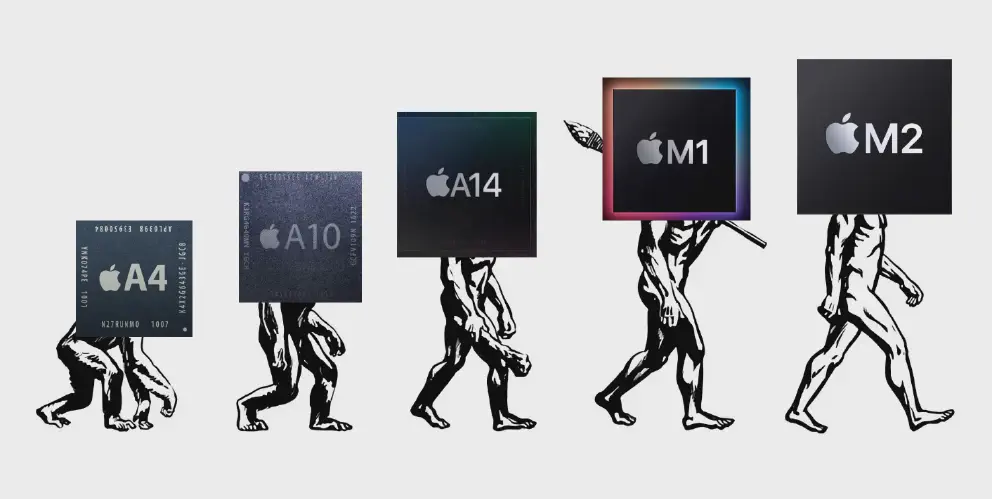
Apple came a long way from a simple chip that powers the first iPad. Here a general look how Apple Silicon fare over the years
Healthy competition is always good for everyone because it brings the drive for people to be the best version of oneself. Intel is a dominant player in the microprocessor market. Dominance is so high that you basically get what Intel gives for a very high price. The smartphone revolution has changed that and with billions and billions of dollars of research went into making the most powerful hand computers ever known to man, we are now in the age where modified versions of mobile microprocessors can compete and beat out processors that are meant to be use on laptops and sometimes desktop.
Leading this charge is Apple who in the past decade has been constantly making the most powerful and efficient mobile processor on the market that is powering their best selling products: iPhones and iPads. Their derivatives also make billions of dollars for Apple such as the AirPods, Apple Watch, Apple TV and HomePods.
At WWDC 2020, Apple announced that they are moving away from Intel for their Macs and started to use their own solution called Apple Silicon, which is a scaled up version of the mobile processors. This document tracks the evolution of the Apple Silicon over time and compares it with contemporary mobile / desktop chips on the market, such as from Intel and AMD.
Apple Silicon Overview
Apple Silicon is Apple’s scaled up version of microprocessor that used to run on mobile platforms like the iPad and iPhones which are now used to run all of their Macs. Apple Silicon was first announced in June 2020 during WWDC presentation and their first products were unveiled in a November 2020 event. The first Apple Silicon is called the M1 which was used in MacBook Air, MacBook Pro and Mac Mini.
However, as of October 2022, the only holdout is the Mac Pro which is a low volume workstation Mac that still runs on Intel’s server-grade processor Xeon.
Intel Mobile Platform Overview
In personal computing, be it laptops or desktop, Intel is the microprocessor king. Despite having lost Apple as a major client, PCs are outselling Macs by a ratio of 9:1 and Intel has consistently outselling their major competitor AMD by a ratio of 2:1.
Intel’s biggest misstep is not taking the smartphone revolution which at one point, Apple actually asked Intel to develop a chip for mobile phones. How things would change if Intel actually delivered.
Despite many of Intel’s solutions shortcomings (the chips are power hungry, runs very hot), many still choose Intel and x86 platforms because many businesses still relies on Microsoft Windows and Linux. This is further boosted by game developers who choose Windows/Intel over Macs because of the bigger market share.
Qualcomm is a semiconductor designer based in San Diego. They made a name for themselves supplying most of the chips that power most of the Android phones on the planet. And as you remember, the smartphone revolution which started around 2007 changed everything. And Qualcomm was one of the companies that capitalized on the demand of new smartphones.
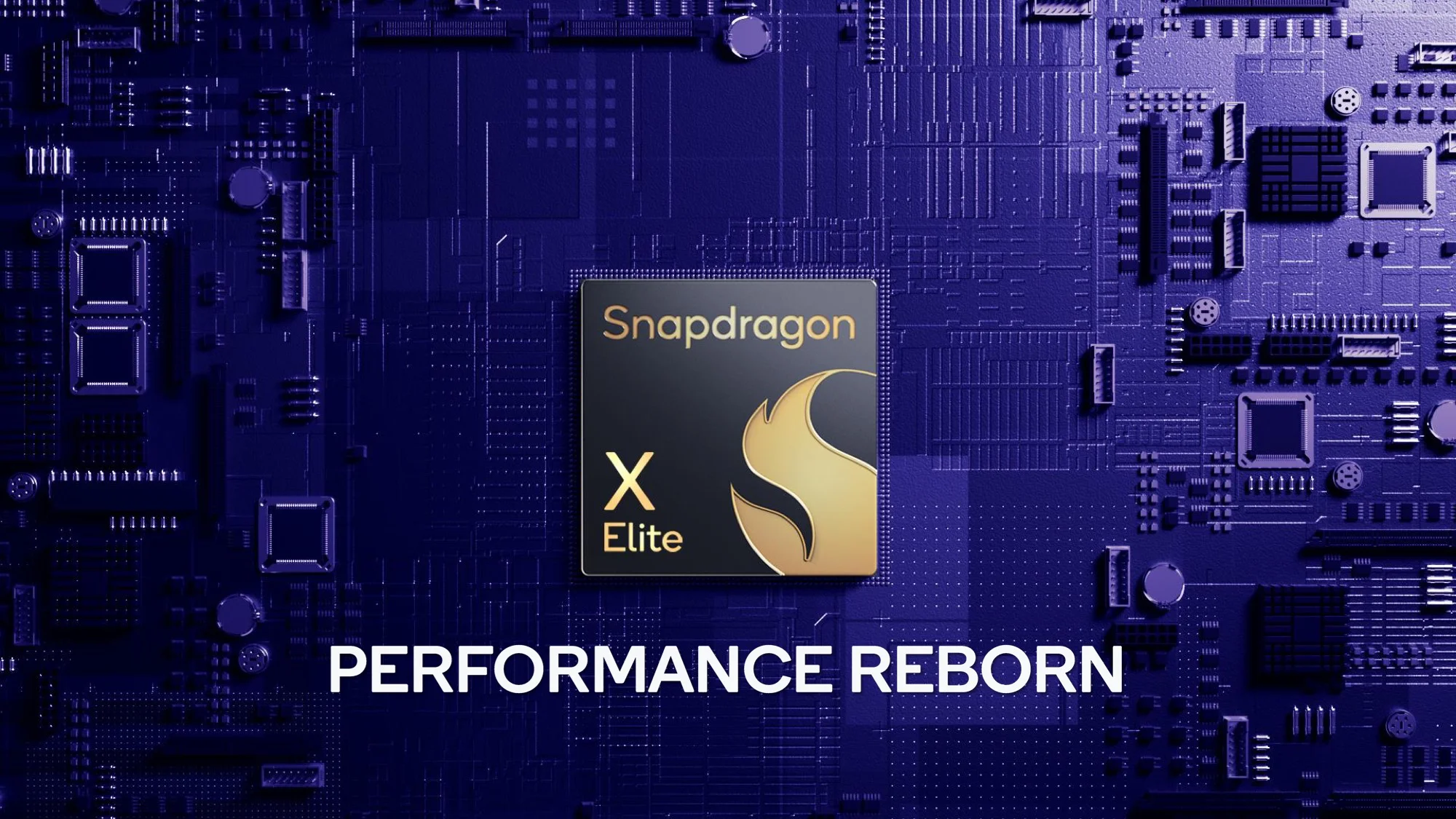
Now, building up experience from designing super chips for mobile phones, they are branching towards providing chips that are good enough to be put on laptops. Enter Qualcomm’s SnapDragon X Elite.
The result is they unveiled their first product, the SnapDragon X Elite in October 2023 but went to market only in June 2024. The initial impression that the SnapDragon X Elite manages is to be on par with Intel’s and Apple’s offerings, which is good news.
Companies like Microsoft also have capitalized on the new features that the SnapDragon X Elite provides like NPU which enables AI-powered features like Recall - capturing screenshots of your computer and smartly cataloging everything that it sees.
Overall, a new player has entered the chat. It is just what we need, good old-fashioned healthy competition in a capitalist market to push the needle.
The Evolution
Year
Apple Silicon
Intel
Mid 2020
A12Z in Mac Mini DTK
First announcement of Macs moving to Apple Silicon
Introduces a Development Transition Kit. A Mac Mini with A12Z chip (that was used in 2020 iPad Pro) but running macOS. Not meant for production
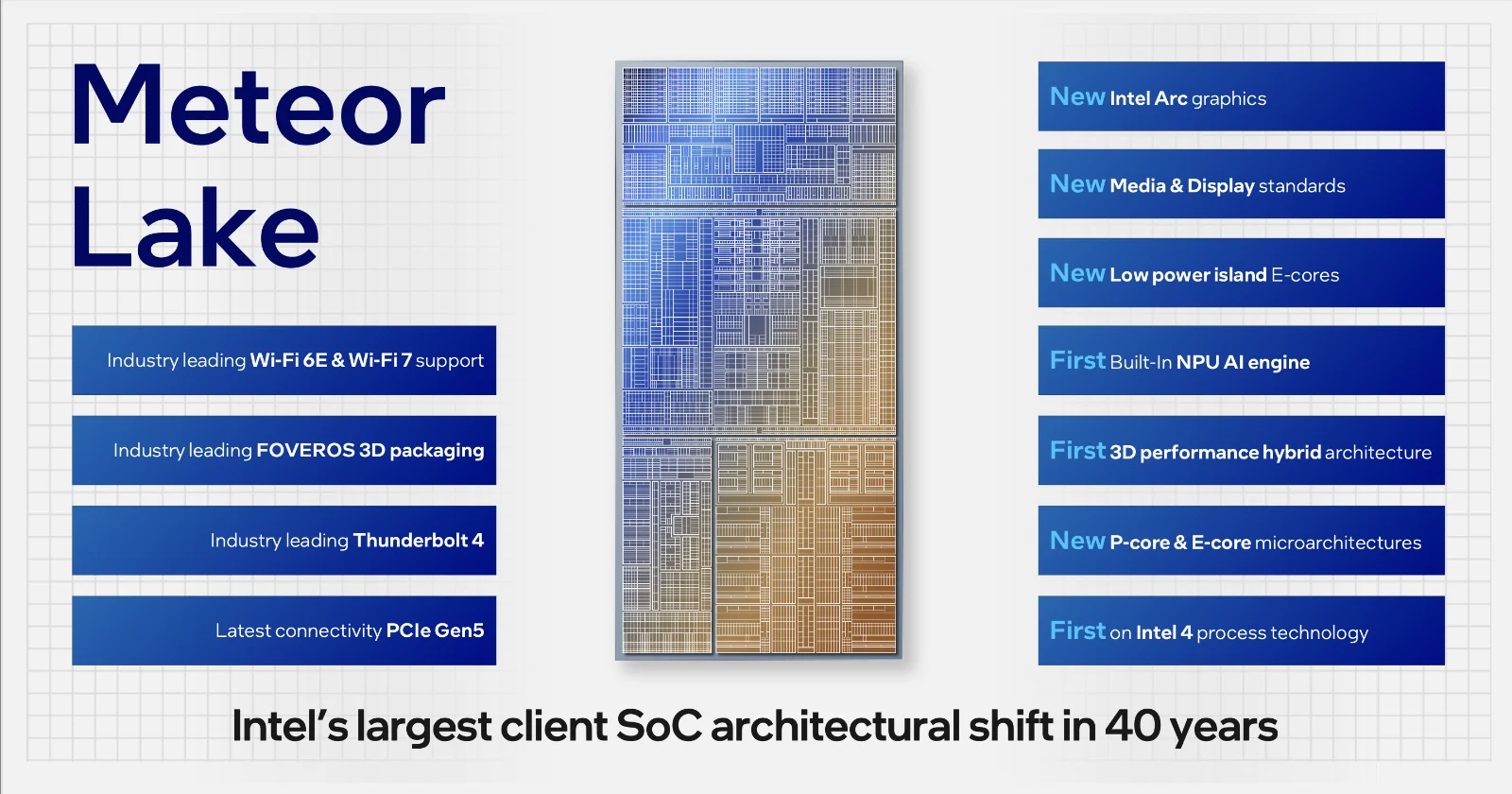
Core Ultra 9 285/275, Core Ultra 5 225/235/245 series
Launched in Q1 2025. TSMC N3B lithography.
Up to 24 CPU cores. Up to 8 performance and 16 efficiency cores. Clock speed up to 5.6 GHz. Base clock speed for performance 2.5 GHz and 1.9 GHz for efficiency cores.
Up to 182 TDP.
Up to 256GB memory support. ECC also supported
On board Intel graphics GPU
On board Intel AI BOost NPU
Late 2025
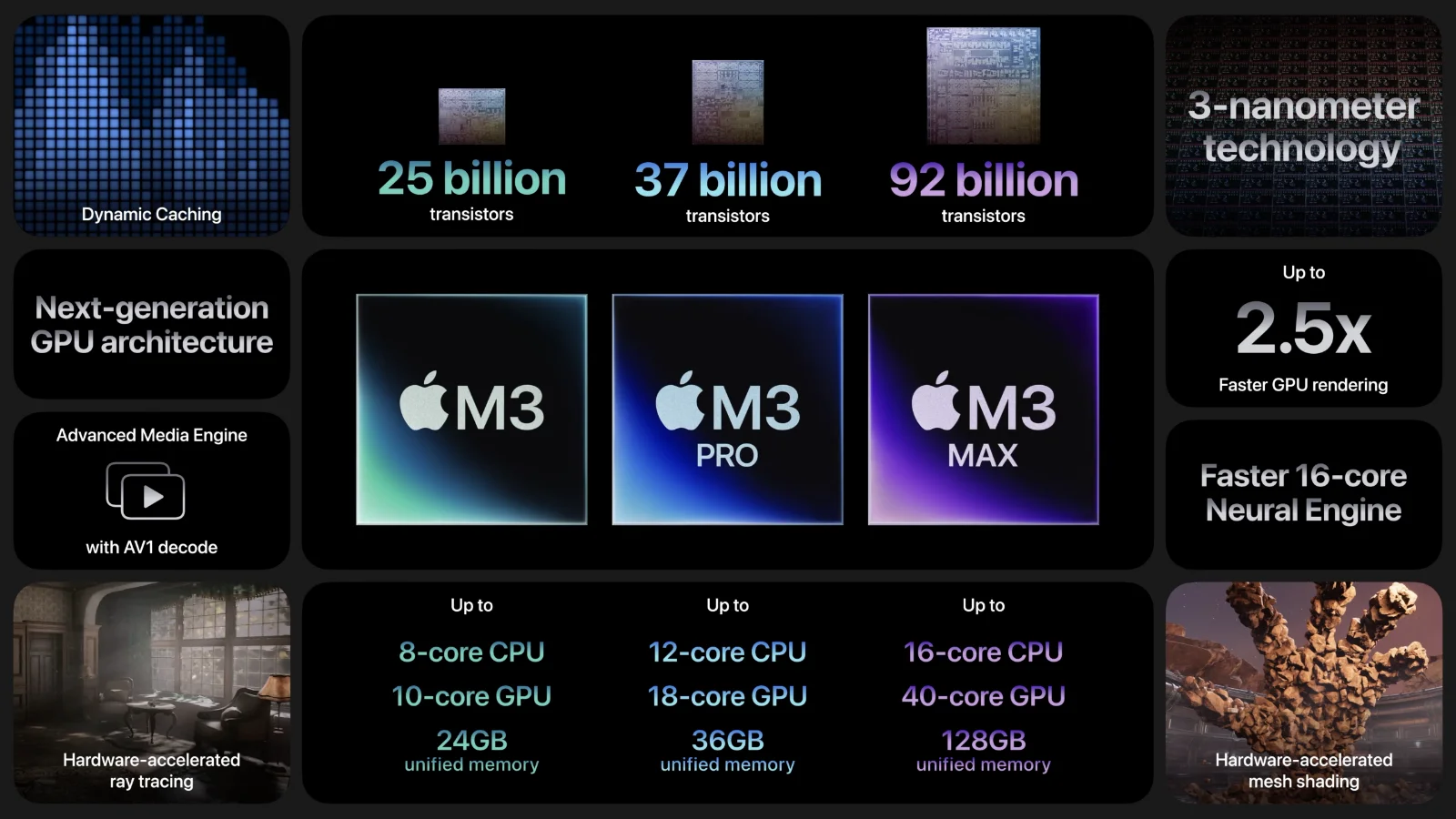
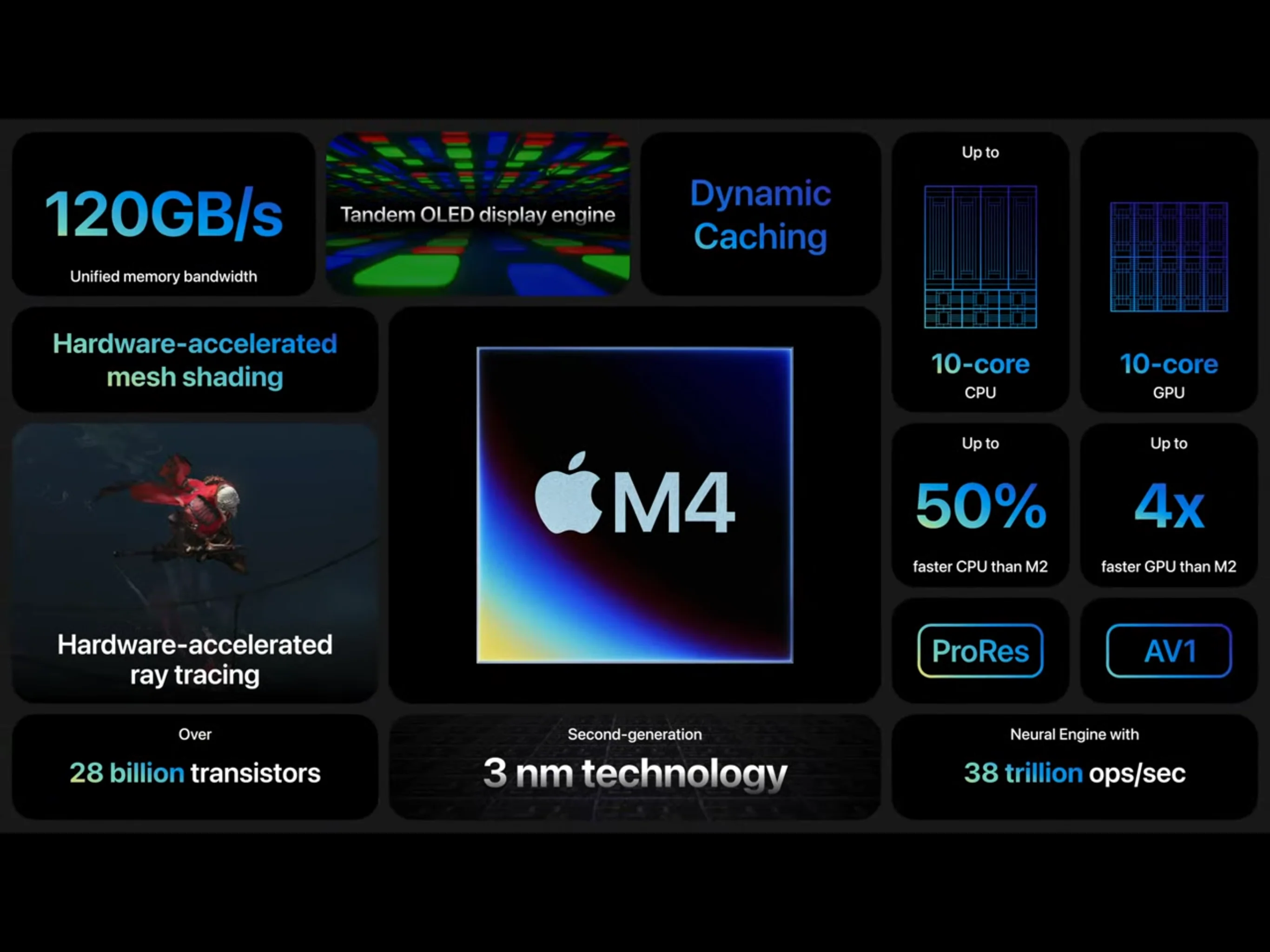
M5
Announced on October 2025 via press release
3rd generation 3nm manufacturing process
10-core GPU, 10-core CPU, and 16-core NPU
Neural Accelerators on GPU-cores, updated shader cores. Promises 40% better gaming performance than the M4.
Supports up to 32GB memory on some models. Storage controller upgraded to support up to 4TB drive
Faster memory bandwidth at 156GB/s
Supports 2x 6K displays or 1x 8K display
First launched on iPad Pro, MacBook Pro and Vision Pro
Core Ultra 5 235 series
Launched in Q3 2025. TSMC 3NB litography.
Up to 14 CPU cores. 6 Performance, 8 Efficiency cores.
Up to 5GHz clock speed. Base clock speed is 2.2 GHz for performance and 1.6 GHz for efficiency
256GB memory support
Onboard Intel Graphics
Onboard NPU cores
Early 2026
M5 Pro / M5 Max
Launched in Q1 2026. TSMC 3NB litography
Fusion Architecture: First chiplet design. CPU and GPU are different dies stitched together in a single package.
M5 Pro and M5 Max share the same CPU cores: 15-core to 18-core CPU. 5 or 6 super cores and 10 or 12 performance cores. CPU dies also handles I/O.
New super cores which is above performance core. M5 chip retcon to have 4 super cores instead of 4 performance cores.
M5 Pro has 16 or 20 core GPU while M5 Max has 32-core GPU. With hardware accelerated ray tracing.
16-core Neural Engine but with higher performance
Neural Accelerators
307GB/s memory bandwidth for M5 Pro and 460 GB/s for M5 Max
A18 Pro
Launched in Q3 2025 for the iPhone 16 Pro. Relaunched for the MacBook Neo in Q1 2026. TSMC 3nm process.
6-core CPU, 5-core GPU, 16-core NPU, ray tracing and mesh shading support.
From 8 cores to 16 cores, 4.7 GHz to 5.1 GHz clock speed.
Up to Intel B390 GPU for graphics.
NPU 5 cores
LP5/x memory support. Up to 96 GB memory support
Chiplet design
Core Ultra Series 7
Launched March 2026
270K PLus - 8 performance cores, 16 efficiency cores
Intel Graphics (4 Xe Cores)
13 Tops NPU
Up to 36MB Smart Cache
Up to 250W TDP
Up to 256GB memory support
Late 2026
M6
Launched in Q3 2026.
First Apple 2nm chip. (N2)
12-core CPU (2 super, 4 performance, 6 efficiency) cores, and 12-core GPU. GPU has Neural Accelerators.
First chip to feature dual 16-core NPU Neural Engine
Updated shader core, dynamic caching, and hardware accelerated ray tracing
Up to 32GB memory support with 170GB/s memory bandwidth
M5 Ultra
Launched in Q3 2026
Two M5 Maxes joined together using Ultra Fusion. UltraFusion bandwith is 4.4TB/s
Up to 36-core CPU (12 super and 24 performance) and 80-core GPU. GPU has Dynamic caching, hardware accelerated mesh shading, and ray tracing.
Media engine for hardware accelerated H.264, HEVC, ProRes processing.
32-core NPU (one on each M5 Max die)
Up to 512GB memory support with 1.2TB/s memory bandwidth
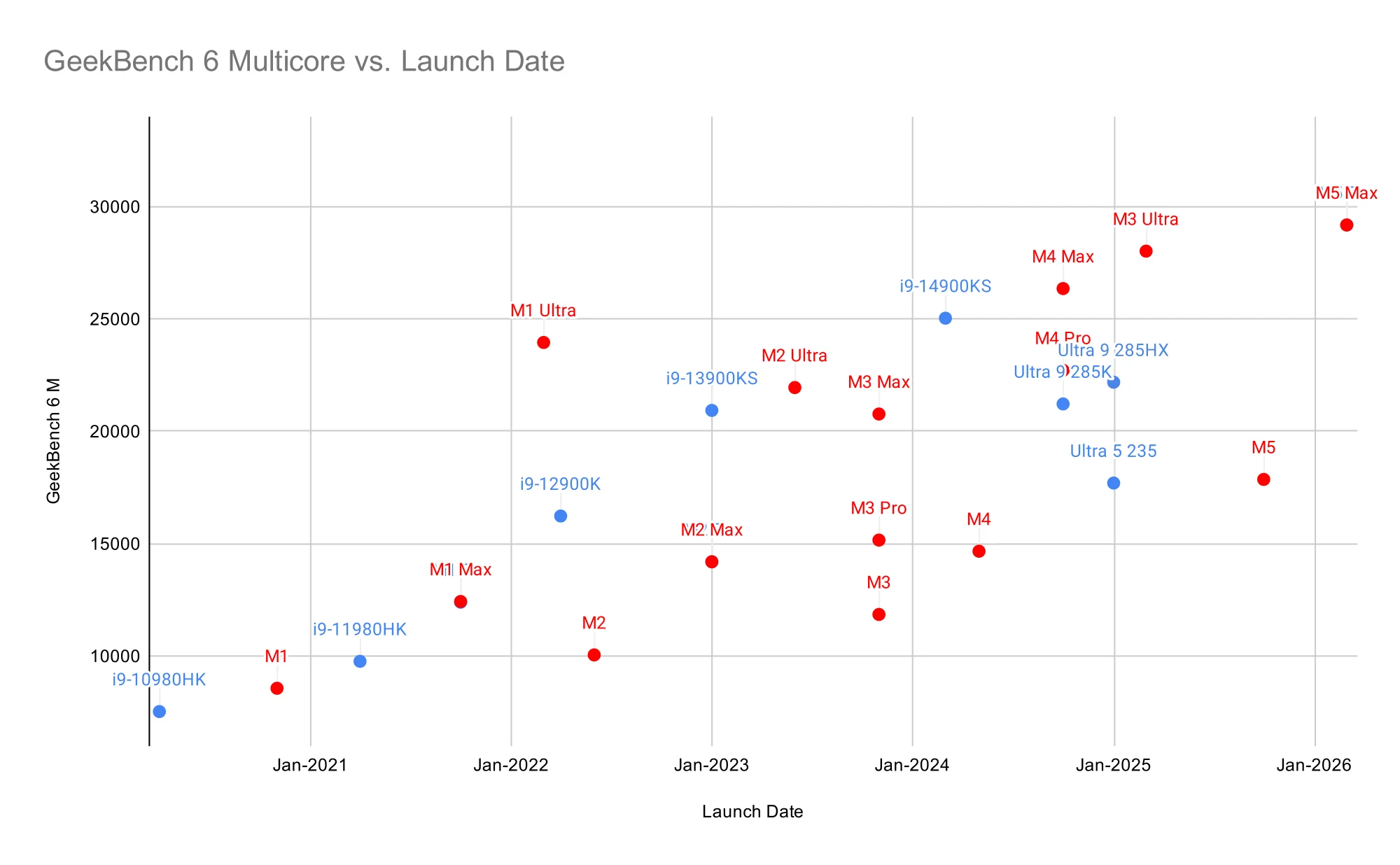
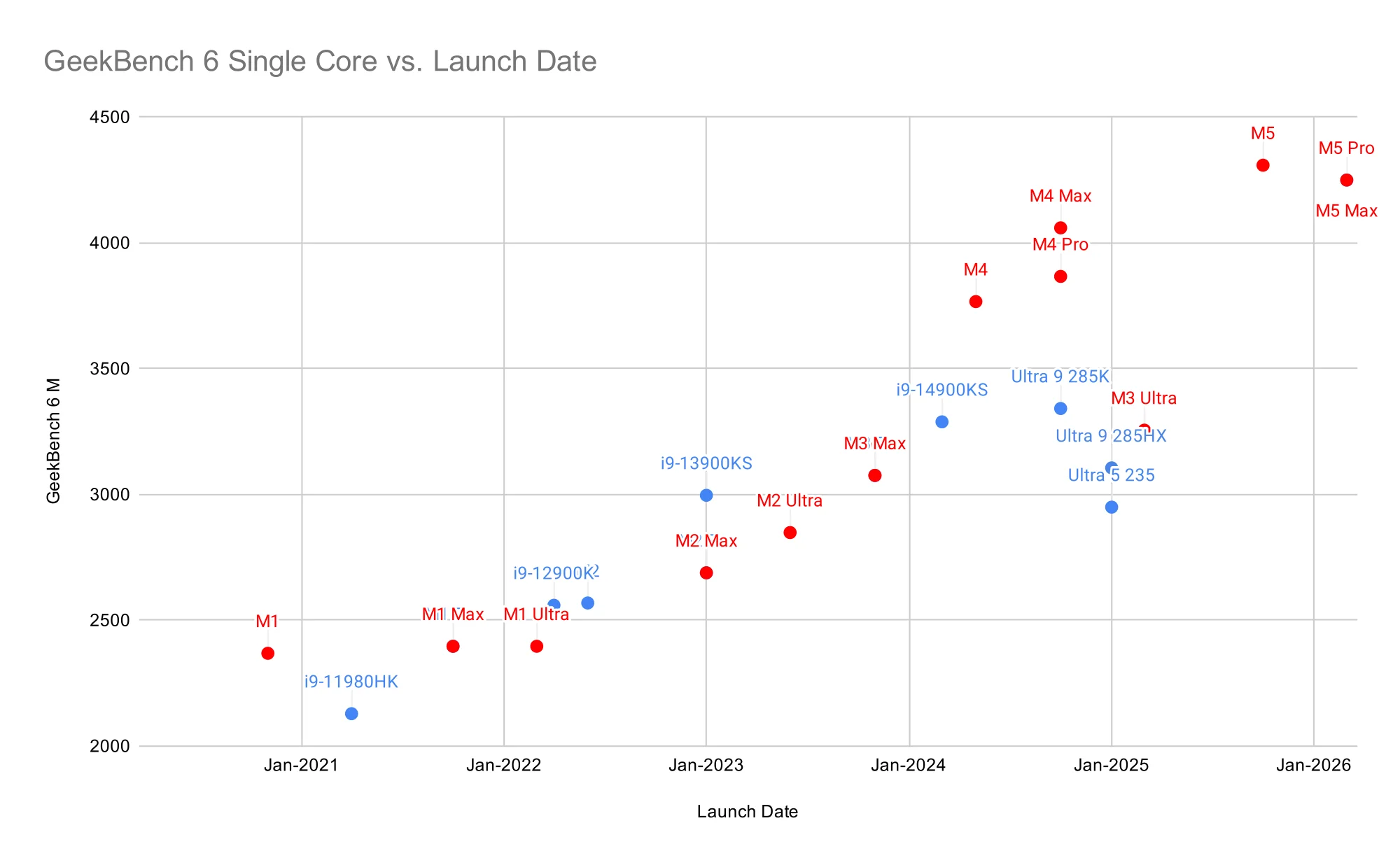
Performance Over Time
Intel refreshes their lineup every 12 months. Apple being a niche player in the personal computing space updates their entire line up every 18 months. So in generation, Intel generation on generation improvements is marginal while Apple has a bigger gap.
Apple has three main advantages over Intel:
Power Efficiency: Being designed as a mobile chipset, power efficiency is everything in Apple Silicon. Consumer chips like the M1 and M2 peaks at 10W and idle in single digits which enable Apple to create passively cooled laptops. Intel does have low wattage models in their line up but performance does not even hold a candle against Apple watt-for-watt.
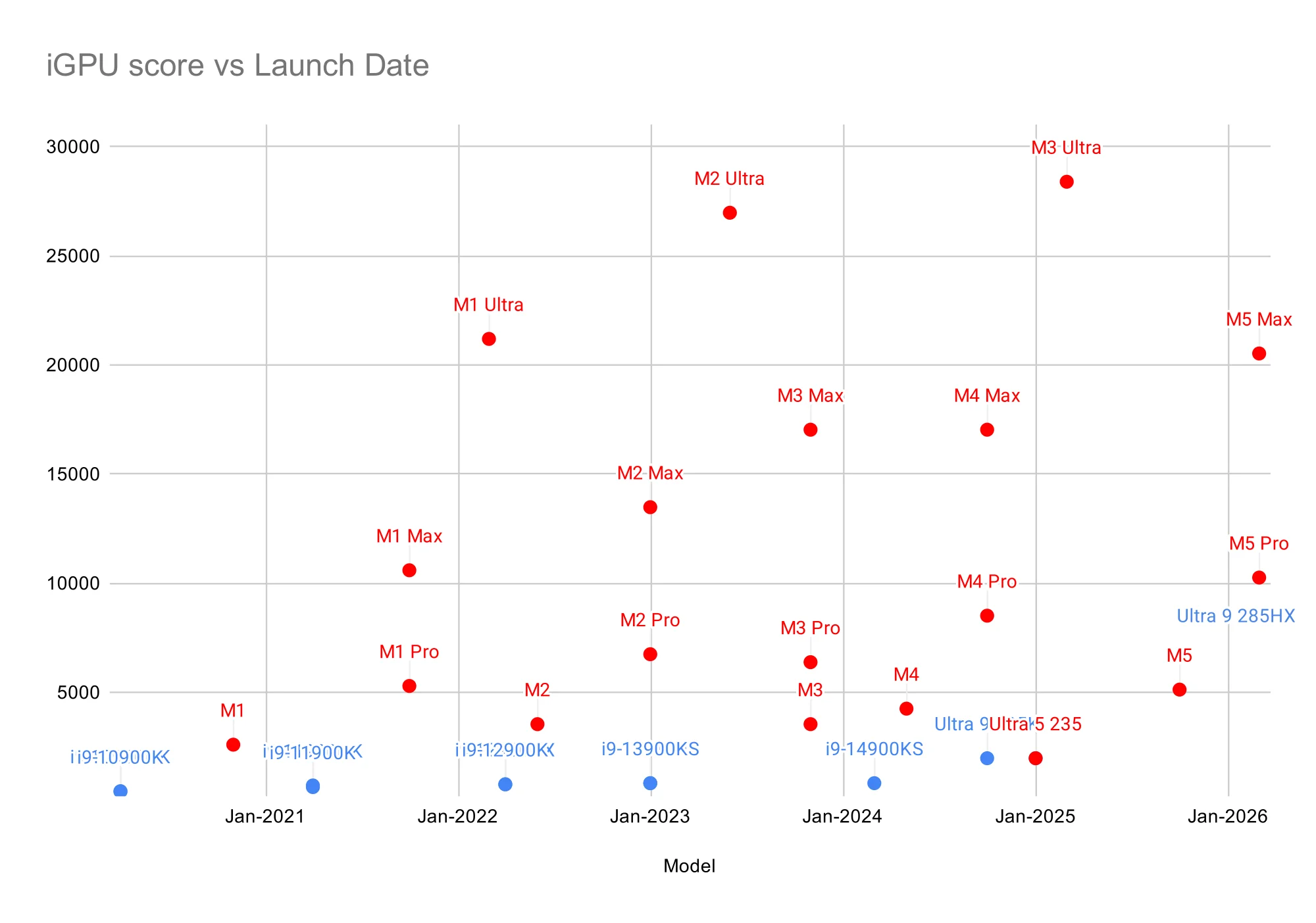
Integrated Graphics: This also goes hand in hand with our third point. But lessons learned from their iPhone projects enables Apple to create a chip with power integrated graphics. Because of Intel’s weak integrated graphics, Intel has to rely on 3rd party solutions like Nvidia and others, which results in overall higher system power usage
Ecosystem: Design philosophy is clearly different because of how both companies work. Intel is a chip merchant and while they do market study they tend to include the kitchen sink, so every instruction or feature imaginable would be there whether you use it or not. Apple on the other hand has total vertical control of the product so some features they don’t want to support would not be in the chip itself. The Apple Silicon team has only 1 customer: the CEO of Apple.
While Apple has these features, let’s not discount Intel just yet. They still have their advantages
Market Share: Right now, in personal computing and server space, the x86 still reigns supreme. This means that a lot of programs out there are still optimized for the x86 architecture. This is most prevalent in gaming titles. Gaming is a big business now where some AAA titles cost $100s of millions to produce. And the situation in Mac gaming is a catch-22: there’s not much gaming titles because the market is small, the market is small because there’s not many gaming titles.
Performance drive: Performance at all cost ensures that Intel chips will be championed by enthusiasts and business users alike. Yes, an Intel chip that is optimized will outperform an Apple Silicon chip in raw power. But that Intel machine will be more power hungry and bulkier, a fact that somehow does not affect a majority of power users.
Business Focus: Apple is into a lot of things, but they are not a chip merchant. There are pluses and minuses in Apple’s approach. Intel, on the other hand, is a full fledge chip merchant which entire business is selling microprocessors. Apple might have more engineers than Intel, but all of Intel engineers are focused on making microprocessors. One big differentor of Intel is the update cycle. For Apple to update from M1 to M2, Intel has released two generations of their flagship chip. Right now Apple might have the leg up into things, but in the future, who knows?
In terms of raw performance, Apple Silicon is surprisingly competitive and on occasion, can beat an established company like Intel. Ecosystem is also a great feature of Apple Silicon that will be Apple’s trump card in the future.
Intel on the other hand, is a veteran player and does know how to fight when the competition and setbacks kicks in. AMD, Cyrix, x86-64, Itanium, Meltdown, Qualcomm, Apple and Samsung are issues and competition that Intel has to fight off over the years and so far, Intel does not seem to be on the verge of collapse. Being at the top of the game for so long takes skills and a little bit of luck.
Plug
Support this free website by visiting my Amazon affiliate links. Any purchase you make will give me a cut without any extra cost to you