Apple Is No Longer a Product Company
In late July, Tim Cook delivered his final earnings call as Apple’s CEO, announcing the company’s best third quarter in history. While headlines focused on warnings about component price volatility, a deeper story emerged from the financial reports: Apple’s rapid evolution from a hardware giant to a services powerhouse.
For years, Apple was synonymous with iconic products — the iPhone, iPad, and Mac. But today, Apple’s fastest-growing business isn’t a device you can hold: it’s services. The transformation has been remarkable, and it’s reshaping both Apple’s business model and the tech industry itself. Apple is no longer a product company, or least it will not be in the future.
The Expanding Apple Services Ecosystem
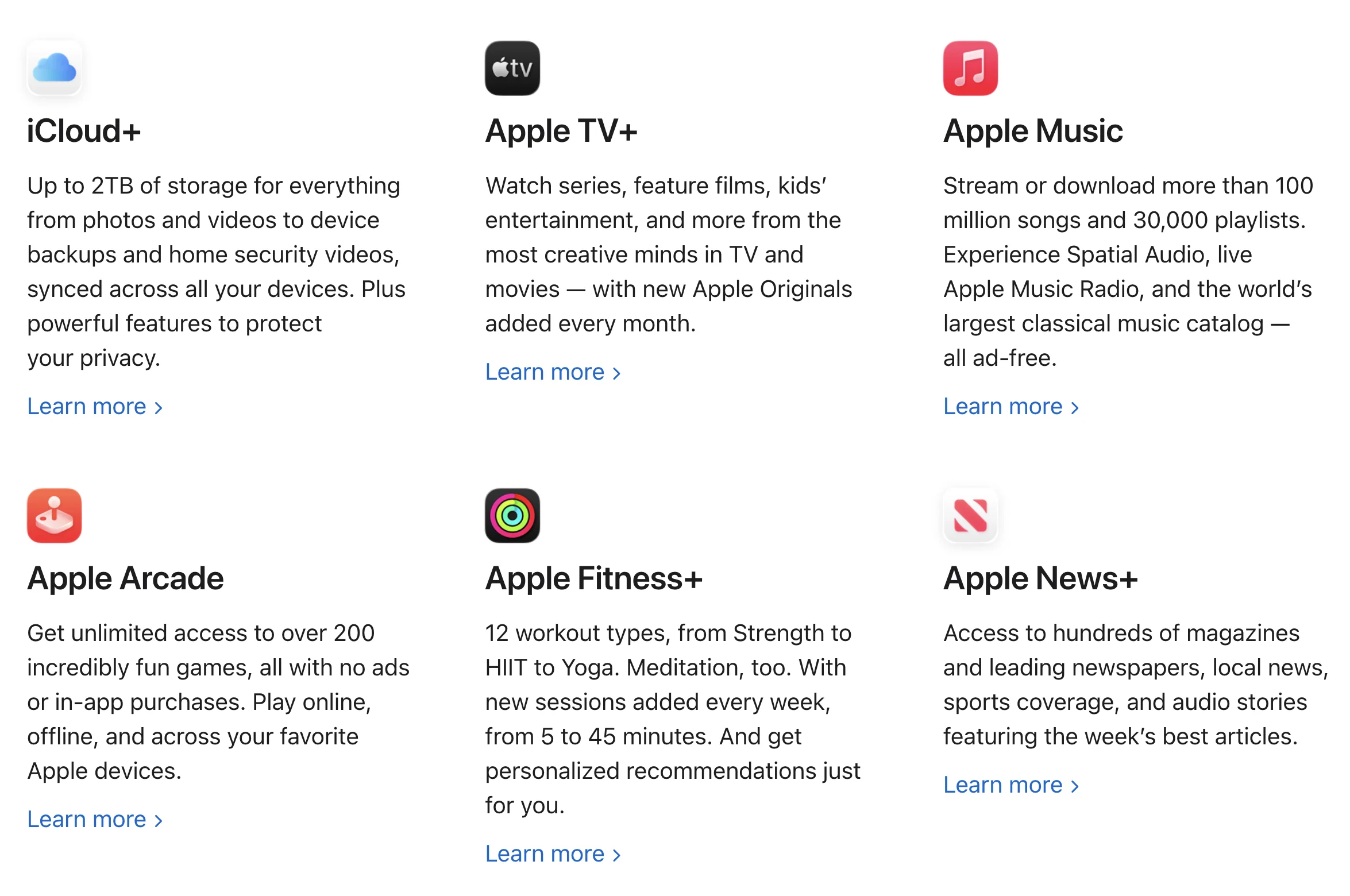
Apple’s suite of services has grown impressively:
- iCloud: After early missteps with .Mac, iTools, and MobileMe, iCloud has become Apple’s most effective cloud solution, offering seamless storage and backup that tightly integrates with Apple’s ecosystem, especially Photos.
- TV+: Apple’s video streaming service, which also supports rentals and purchases.
- Music: A global music streaming platform.
- Fitness+: Online fitness classes with instructors, capitalizing on health trends.
- News+: A curated magazine service, available in select countries.
- Family Sharing: Allows up to six people to share subscriptions and manage family controls like screen time.
- Arcade: A game subscription service, offering a rotating selection of games.
- Apple One: Bundles Apple’s services for a single monthly fee, simplifying the experience.
- Apple Pay: Integrated with Apple Wallet, you put your credit card and pay using your iPhone or Apple Watch. Apple gets a 0.15% cut for each transaction.
Why Services Work for Apple
Apple has mastered the art of seamless integration. For example, backing up photos “just works” for most users, and Family Sharing makes it easy to manage subscriptions and parental controls. Although Apple’s storage tiers are limited and device storage is not upgradable, this limitation nudges users toward paid iCloud plans.
Another example is Apple Pay. Seamlessly built into your iPhone Wallet, Apple Pay has been the default—and for a long time, the only—mobile payment solution available on iPhone, blocking third-party credit card payment apps until very recently, but for competitors, it’s already too late. Apple collects a small fee of 0.15% per transaction, yet with an impressive 92% market share, Apple Pay processed a staggering $9.5 trillion in transactions globally in 2025.
The Growth Story: Numbers Tell the Tale
Since the introduction of iCloud in 2011, services have gone from being a minor contributor to a central pillar of Apple’s business. In 2011, services generated $9.4 billion, just 8.6% of total sales. By the third quarter of 2026, that number soared to $30.8 billion — nearly 28% of total sales. Even more impressive are the margins: Apple’s services segment brought in $30.8 billion in revenue while costing only $7.5 billion to operate, yielding a staggering 75% profit margin.
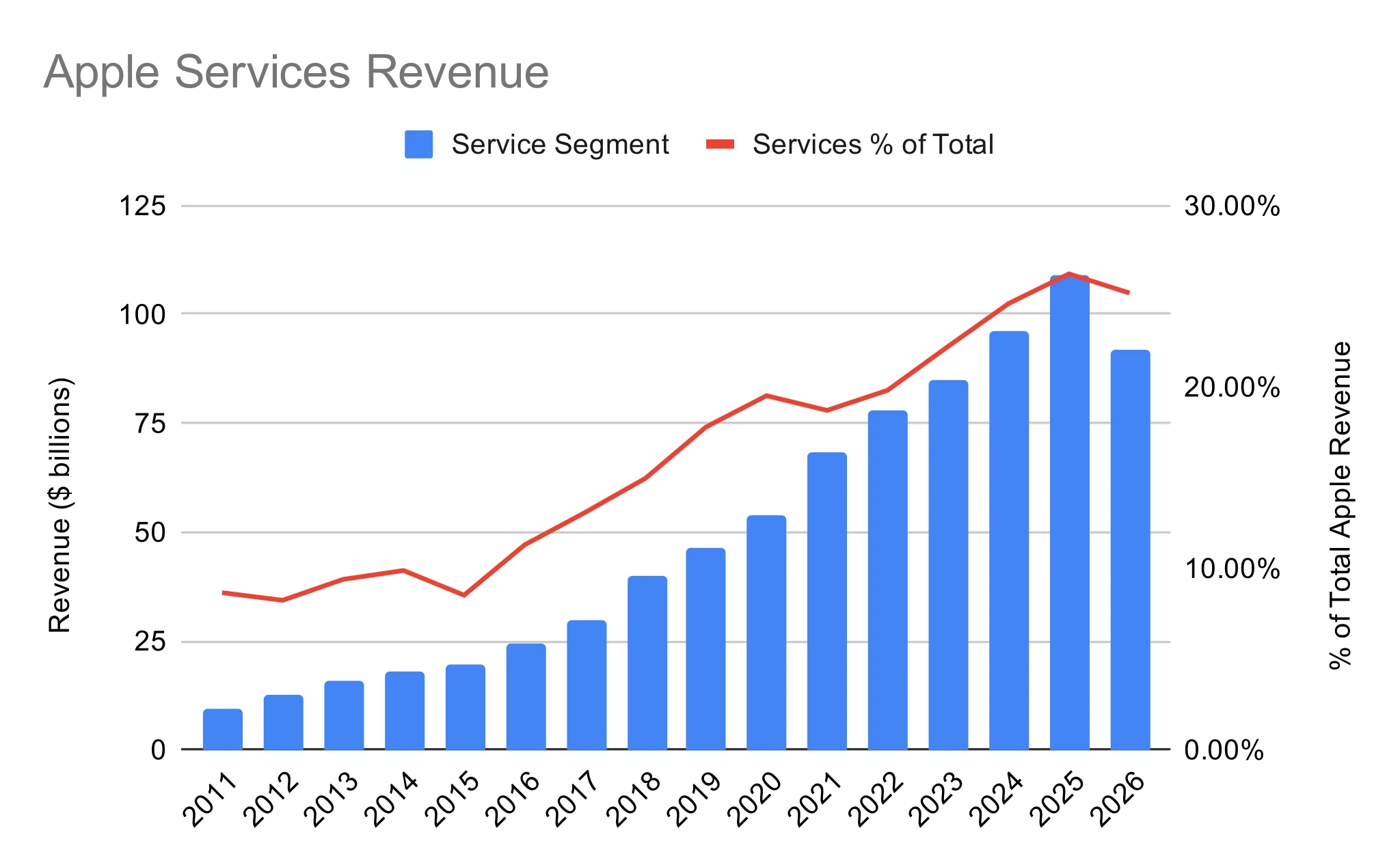
| Year | Service Segment | All Segment | Services % of Total |
|---|---|---|---|
| 2011 | 9.37 | 108.25 | 8.66 |
| 2012 | 12.89 | 156.51 | 8.24 |
| 2013 | 16.05 | 170.91 | 9.39 |
| 2014 | 18.06 | 182.80 | 9.88 |
| 2015 | 19.91 | 233.71 | 8.52 |
| 2016 | 24.35 | 215.64 | 11.29 |
| 2017 | 29.98 | 229.23 | 13.08 |
| 2018 | 39.75 | 265.60 | 14.97 |
| 2019 | 46.29 | 260.17 | 17.79 |
| 2020 | 53.77 | 275.52 | 19.52 |
| 2021 | 68.43 | 365.82 | 18.71 |
| 2022 | 78.13 | 394.33 | 19.81 |
| 2023 | 85.20 | 383.26 | 22.23 |
| 2024 | 96.17 | 391.04 | 24.59 |
| 2025 | 109.16 | 416.16 | 26.23 |
| 2026* | 91.73 | 364.36 | 25.18 |
*2026 numbers are up to 3rd quarter as time of writing.
A quick look at the numbers over the years:
- 2011: $9.4B services revenue (8.6% of total)
- 2020: $53.8B (19.5%)
- 2026: $91.7B (25.2%)
At this pace, services could account for half of Apple’s revenue within the next 5-7 years.
Conclusion: The Real Winners
Apple’s transformation is nearly complete. While the company doesn’t position itself as a services-first business, the numbers don’t lie. The services segment has grown from less than 10% of Apple’s revenue to nearly a quarter, with no signs of slowing. As more users subscribe to Apple One and other digital offerings, the company’s future looks less tied to the next iPhone and more to the value it delivers through its growing digital ecosystem.
Apple is no longer just a product company — it’s a platform for services, and the real winners are those who saw this shift coming.
Plug
Support this free website by visiting my Amazon affiliate links. Any purchase you make will give me a cut without any extra cost to you
| Base | Pro | |
|---|---|---|
| iPhones | iPhone 16 / iPhone 16 Plus - (Amazon) | iPhone 17 Pro / iPhone 17 Pro Max - (Amazon) |
| iPhone Accessories | Find them at Amazon | |
| Watch | Apple Watch SE (Amazon) / Apple Watch Series 11 | Apple Watch Ultra 3 (Amazon) |
| AirPods | AirPods 4 (Amazon) | AirPods Pro 3 (Amazon) / AirPods Max (Amazon) |
| iPad | iPad 10 (Amazon) / iPad Mini (Amazon) | iPad Air M3 (Amazon) / iPad Pro M5 (Amazon) |
| Laptops | MacBook Air M3 (Amazon) | MacBook Pro M5 (Amazon) / MacBook Pro M4 Pro/ M4 Max (Amazon) |
| Desktop | Mac Mini M4 / M4 Pro (Amazon) / iMac M4 (Amazon) | Mac Studio / Mac Pro |
| Displays | Studio Display (Amazon) | Pro Display XDR (Amazon) |
Other Ecosystem Items
Love this? Consider buying me a coffee!