iPhone Duo
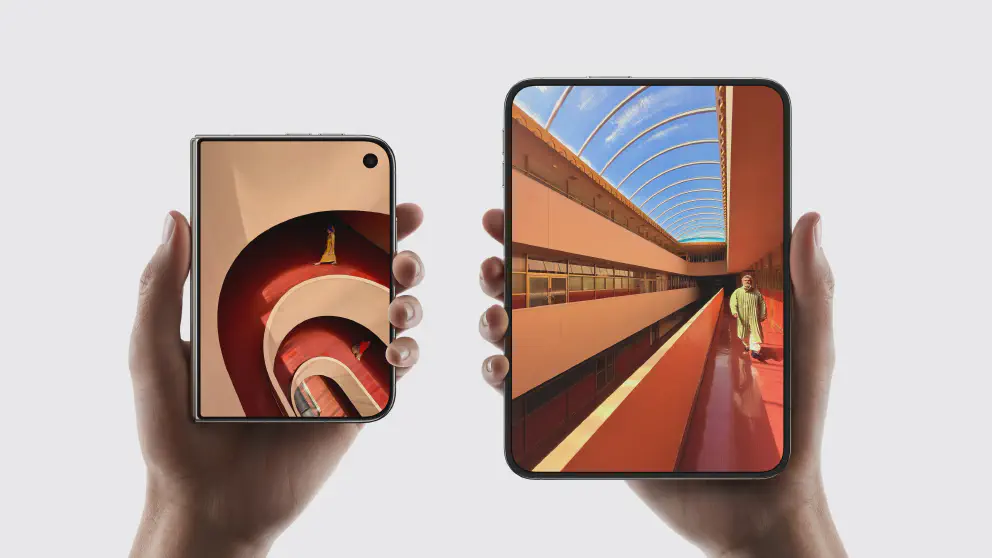
Apple has finally launched its first foldable smartphone: the iPhone Duo. In typical fashion, Apple is the guest who shows up late to the party — but always brings the expensive wine.
A Brief History of Foldable Displays
Foldable displays are a lot older than most people assume. The technology was first developed back in the 1970s, by Xerox, of all companies. From there it lived a quiet life, drifting in and out of demo stages for decades without ever finding a real product to call home — that is, until the early 2010s, when the pieces finally started coming together.
Samsung got there first in a meaningful way, curving a display around the edge of a phone with the Galaxy Note Edge. It was a neat trick, but ultimately a gimmick; the design never really caught on. Things got more serious in the early 2020s as the underlying technology matured. According to reporter Mark Gurman, it was around this time that then-Apple-CEO Tim Cook saw folding display technology during a trip to Shanghai and told the company to start working on it in earnest.
True to form, Apple wasn’t interested in being first. It waited until the technology met Apple’s own standards — a company that, famously, works on far more projects than it ever ships.
Motivation: Why Foldables, Why Now?
Before getting into the phone itself, it’s worth asking the obvious question: why foldables, and why now?
Why foldables? It’s easy to write foldables off as a trend or a gimmick, but there was a whole tech world that existed before everyone’s attention lived inside a glass slab. Before the smartphone standardized everything into a flat brick, most of the devices we used every day were built around the act of folding. Flip phones were, for a while, as popular as candy-bar phones — small in your pocket, opened up when you needed them. Laptops are foldable devices in their own right: you flip up the screen to use it, exactly the way Palm-era handhelds once worked. Go back further and even books are foldable objects. You don’t mail a letter as a flat sheet — you fold it into an envelope. A notepad is a folding scratch pad. Arguably, folding is one of the most natural design instincts there is.
Why now? The short answer is that technology has finally caught up. The longer answer is that it’s reached the point of maturity where early adopters can actually daily drive it — and daily driving is the key phrase. It’s the combination of raw performance (a 2nm chip delivering desktop-class computing in the palm of your hand) and durability (IP68 water and dust resistance on the iPhone Duo) that turns a folding phone from a toy into a genuine tool. As Apple’s new CEO, John Ternus, put it when introducing the device: it’s “your personal intelligent hub.”
Design
Form Factor
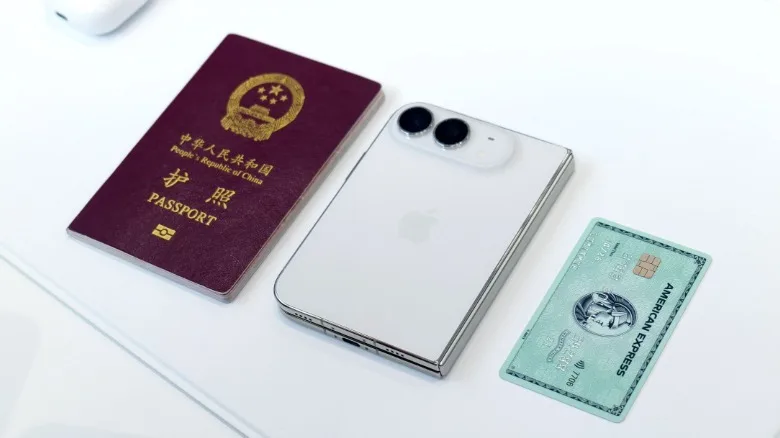
Since foldables entered the market, the form factor has largely split into two camps: the long book-style “brick” and the clamshell.
The brick shape was popularized by the Samsung Galaxy Fold series, with an outer screen around a tall 21:9 ratio and an inner display closer to 4:3 when unfolded. The clamshell, meanwhile, calls back to old-school flip phones — compact when closed, opening to reveal a larger display, with an outer aspect ratio near 1:1 and an inner ratio around 21:9, the same as the Galaxy Fold’s inner screen.
Apple’s twist was to design around an actual paper standard rather than a screen ratio. The iPhone Duo follows a 1:1.4 aspect ratio — the B-series international paper standard, specifically B7, the size used for passports. The payoff is real: the Duo has the largest usable screen coverage for 16:9 and 4:3 video of any iPhone, outer or inner display included. That proportion also happens to be close to the aspect ratio of most books (roughly 1.5:1 to 1.6:1), which makes holding and using the Duo feel oddly familiar right out of the box. You know Apple got something right when competitors started rolling out the same form factor as soon as the rumors hit.
Buttons
The volume controls, traditionally on the left edge of an iPhone, have moved to the top — for obvious reasons given the fold. There’s no dedicated up/down orientation for them either; they simply follow whichever way the screen is currently facing. The Action Button (formerly the mute switch) is gone entirely. The side button and Camera Control, meanwhile, sit exactly where you’d expect them to. Apple clearly wants the Duo to feel new without feeling unfamiliar.
Camera Bump (Or Lack Thereof)
Unfolded, the iPhone Duo measures just 5.2mm thick — the thinnest iPhone Apple has ever made, even slimmer than the iPhone Air’s 5.6mm. There’s also no oversized camera bump to speak of. Despite packing two batteries into the chassis, Apple still managed to fit everything in without the pronounced hump that defines the iPhone Air’s camera housing.
Hinge and Crease
The hardest part to engineer is the hinge. With over 100 components and materials including carbon fiber and titanium, Apple spend a lot of time on the hinge to make it dustproof, waterproof, able to stop at almost any angle, and durable for everyday use.
The single biggest challenge for any foldable phone is the hinge — and everything that comes with it. Dust and grime work their way into the mechanism over time, and in the worst cases, debris gets lodged inside it entirely. Constant folding and unfolding makes the crease down the middle of the display more visible with age. Run a finger across it and you can feel it. And the inner display itself has historically felt more plasticky than glass, undercutting the premium feel iPhones are known for.
Foldables also have a rocky history when it comes to first impressions. When the original Galaxy Fold launched, early reviewers mistook the display’s protective layer for a removable screen film and peeled it off — not realizing it was part of the display itself. They destroyed their review units within hours.
Apple’s answer to all of this is largely mechanical and material. The hinge itself is built from more than 100 components, including titanium and carbon fiber, engineered for durability over years of use. Where the Galaxy Fold’s hinge only really has two states — open or closed — the iPhone Duo’s hinge can hold at nearly any angle. That flexibility turns the phone into an impromptu alarm clock, a self-standing tripod for selfies, or a small propped-up screen for video. To deal with the crease and the feel of the inner panel, Apple applied a modified version of its Nano-texture coating to the inner display; it comes at the cost of some color accuracy, a trade-off Apple has clearly decided is worth making for a first-generation product. Underneath, the display stack uses ten layers of material — polymer, a titanium base plate, and a specialized adhesive that lets the layers shift against each other as the display folds — to balance stiffness, strength, and flexibility under load.
Apple claims that there is 10 layers of materials including special polymer and titanium backing for the foldable display to maintain shape, form and performance over daily use. A special adhesive is used so that the layers can slide between each other when the display is folded.
Software
Apple’s real advantage has never really been the hardware alone — it’s how tightly the software is built around it. Hardware secrets are hard to keep because they pass through a sprawling global supply chain where leaks are almost inevitable. Software, by contrast, mostly stays inside Apple’s own walls until launch day, and it shows in how polished the experience feels.
A few things stand out:
- Folding animation. Foldables have been on the market for seven or eight years now, and remarkably, none of them bothered to animate the transition between the outer and inner display. Apple did, and it makes switching between screens feel far more intuitive.
The battery, Wi-Fi, and Cellular strength icon has been combined. One of many redesigns on the iOS for the iPhone Duo.
- Layout. iOS 27 has been reworked specifically for the Duo. The dock now sits permanently on the right edge instead of the bottom, a deliberate choice that transitions more naturally when the inner display opens. Rather than resizing the interface the way some Android implementations do, iOS simply extends it. Status elements for Wi-Fi, battery, and cellular have also been redesigned and consolidated.
- Under-display camera. Under-display camera technology isn’t new — Samsung introduced and then quietly abandoned it, because getting a clean display meant sacrificing camera quality. Apple decided that trade-off is worth making anyway, opting for an uninterrupted screen over a punch-hole camera despite years of investment in Dynamic Island.

From Apple's developers documentation, the different 'poses' the iPhone Duo can make for the developer's consideration. In contrast, Samsung Galaxy Fold 8 is just open or closed. - Device “poses.” The Duo is designed to hold a range of positions: fully folded, partially open like a book, laid flat, or standing on its edge. Apple could have let the hinge spring freely open the way Samsung’s does, but chose to engineer a hinge that holds at any point in between, betting that the extra engineering effort is worth the improved usability.
- Camera modes. Plenty of the camera features on the Duo are, arguably, borrowed from Android rivals — but Apple’s execution is, as usual, more refined. Google’s “Made You Look” feature might have started the idea, but putting an actual animated Snoopy on screen to hold a toddler’s attention is the kind of polish only Apple seems able to pull off.
The Little Things
At a glance, it’s tempting to write the iPhone Duo off as just another “look at me” entry in the foldable race. But that’s a bit like saying a Ford Pinto and a Ferrari F40 are the same car because both have seats, doors, and a steering wheel. It’s the little — and not-so-little — details that justify the Duo’s $2,000 price tag:
- A titanium frame, borrowed from the iPhone Air, that makes the phone feel like a single solid piece of engineering rather than a folding assembly.
- MagSafe support.
- The A20 Pro chip, which delivers roughly the raw power of an Apple M1 Max — a chip people still consider plenty fast today — in the palm of your hand.
Conclusion
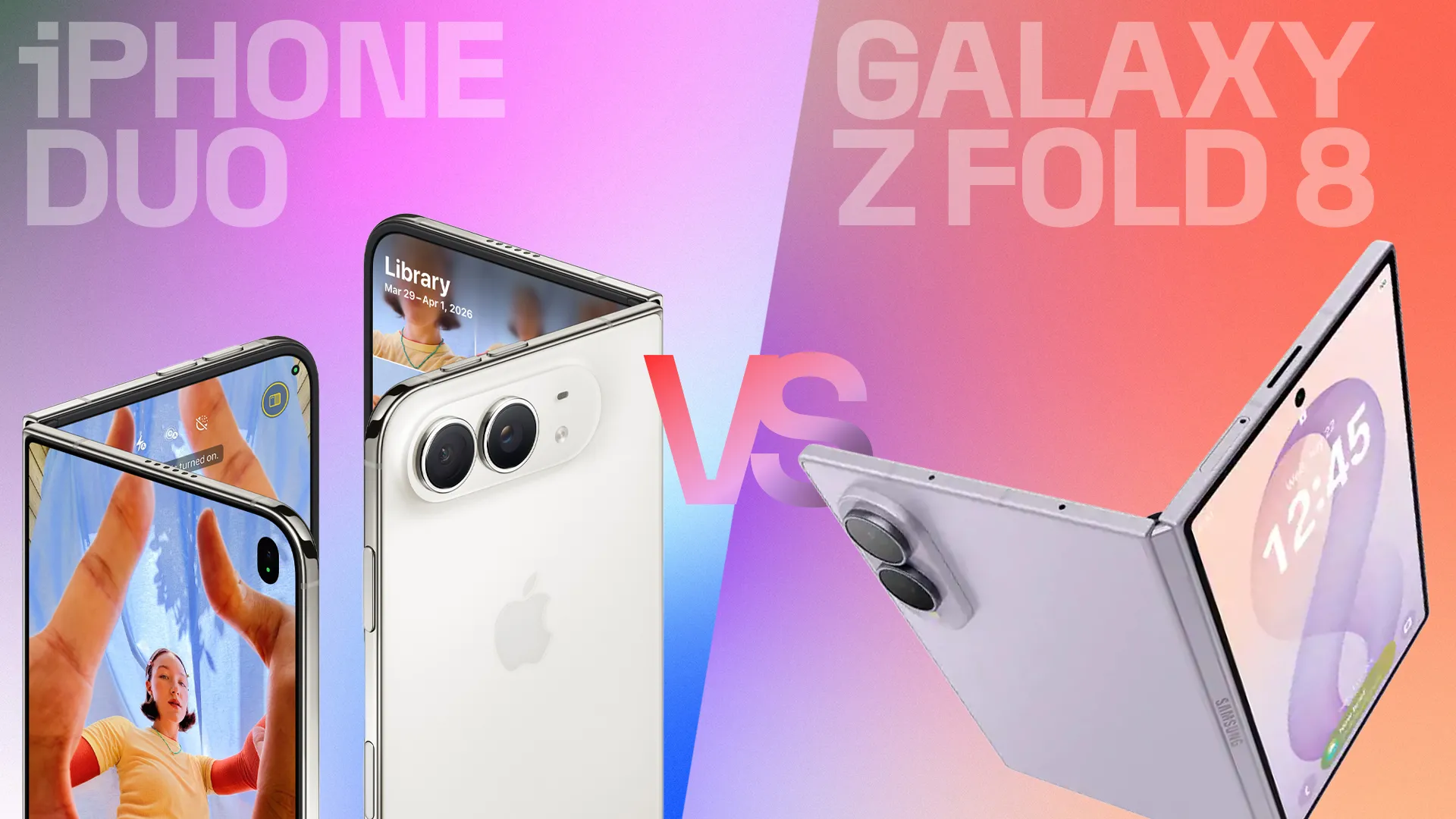
As always, Apple never claims to be first at anything. But when the company finally does have something to say, it tends to be one of the better products in the category. Some will call the $2,000 price tag the usual “Apple tax.” But stack the iPhone Duo against the Samsung Galaxy Fold 8 — just $100 cheaper, with noticeably less to offer in features, performance, and build quality — and it starts to look like Apple has handed the rest of the foldable market its lunch.
Love this? Consider buying me a coffee!